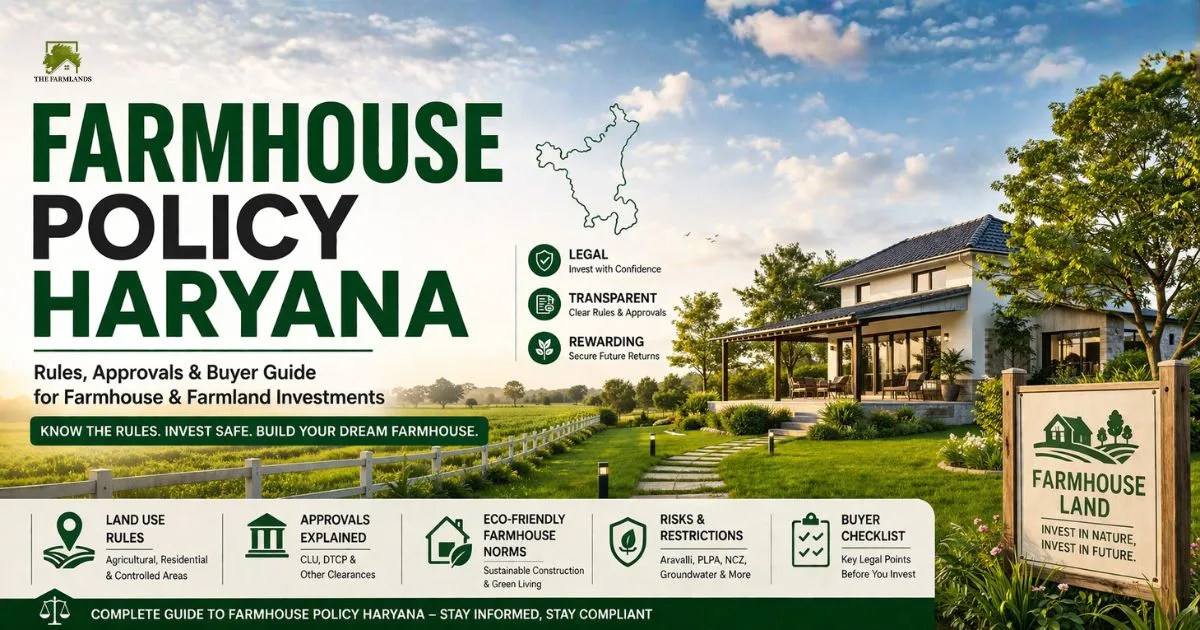
Farmhouses have become a popular choice for people looking for open land, private weekend spaces, organic living and long-term real estate investment around Delhi NCR. In Haryana, the demand is especially strong because locations like Faridabad, Gurugram, Sohna, Sonipat, Karnal and other growth corridors offer better land availability compared to Delhi and Noida.
But there is one important point every buyer must understand clearly: Haryana does not have one single simple “farmhouse policy.”
What people commonly call the farmhouse policy Haryana is actually a combination of land-use rules, controlled-area laws, development plans, eco-friendly farmhouse permissions, low-density colony policies, environmental restrictions and local approvals.
This blog explains the farmhouse rules in Haryana in simple language, including where farmhouses may be allowed, what approvals are needed, what restrictions apply, and what buyers should check before investing.
What Is the Farmhouse Policy in Haryana?
The phrase farmhouse policy Haryana usually refers to the rules under which a person may be allowed to build or own a farmhouse-style property on agricultural or large-format land in Haryana.
In practical terms, Haryana has three major regulatory routes related to farmhouses:
- Standalone eco-friendly farmhouses in agricultural zones
- Eco-friendly farmhouse or low-density housing in residential zones
- Licensed low-density eco-friendly colonies with large farmhouse-style plots
Each route has different conditions, permissions, plot-size rules and development controls. A land parcel that may be suitable under one route may not be suitable under another.
This is why buyers should never rely only on marketing words like “farmhouse land,” “DTCP approved farmhouse,” or “future farmhouse zone.” The real question is whether the land is legally eligible under the relevant Haryana planning framework.
Main Laws That Govern Farmhouses in Haryana
Farmhouse development in Haryana is mainly controlled by the Department of Town and Country Planning, Haryana, along with land revenue, environmental and local authority rules.
The key legal frameworks include:
1. Punjab Scheduled Roads and Controlled Areas Restriction of Unregulated Development Act, 1963
This law controls development in notified controlled areas. It restricts the use of land for purposes other than the approved land use unless permission is taken from the competent authority.
In simple terms, even if land is recorded as agricultural land, a buyer cannot automatically construct a farmhouse on it in a controlled area without checking land-use permissions.
2. Punjab Scheduled Roads and Controlled Areas Restriction of Unregulated Development Rules, 1965
These rules explain the procedure for Change of Land Use, commonly called CLU. They include application procedures, forms, conditions, conversion charges and approval requirements.
For many standalone farmhouse cases, this CLU framework becomes very important.
3. Haryana Development and Regulation of Urban Areas Act, 1975
This law applies when land is developed as a colony. If a developer wants to create multiple large farmhouse-style plots as part of a planned project, a colony licence may be required.
4. Haryana Development and Regulation of Urban Areas Rules, 1976
These rules provide the procedure for colony licences, layout plans, development works, fees, security, roads, services and other obligations.
5. Eco-Friendly Farmhouse and Low-Density Colony Policies
Over the years, Haryana has issued different policies for eco-friendly farmhouses and low-density eco-friendly colonies. Important policy developments include:
- 2014 Low Density Eco-Friendly Colony Policy
- 2020 policy for eco-friendly farmhouse or low-density housing in residential zones
- 2021 policy for eco-friendly farmhouses in agricultural zones
- 2023 policy for planned development of Low Density Eco-Friendly Colonies
These policies are especially important for understanding the modern farmhouse framework in Haryana.
Are Farmhouses Allowed in Haryana?
Yes, farmhouses may be allowed in Haryana, but only under specific conditions.
A farmhouse is not automatically legal just because the land is agricultural. The legality depends on several factors:
- Whether the land falls in a controlled area
- Whether the land is in an agricultural zone, residential zone or another land-use zone
- Whether it is outside restricted buffers
- Whether CLU or licence approval is required
- Whether the site has proper road access
- Whether the land is affected by Aravalli, PLPA, forest, Natural Conservation Zone or environmental restrictions
- Whether building plans are approved
- Whether the intended use is private residential/farm use or commercial use
So, the correct answer is: farmhouses are allowed in Haryana only where the land, zoning, approvals and environmental conditions support it.
Standalone Eco-Friendly Farmhouses in Agricultural Zones
One of the most discussed parts of Haryana’s farmhouse framework is the policy allowing eco-friendly farmhouses in agricultural zones.
Under the agricultural-zone route, a farmhouse is generally understood as a house built by the owner of the farm for main dwelling use, along with limited ancillary use such as watch and ward, servant quarters, farm sheds or animal sheds.
The key idea behind this policy is not to allow random construction everywhere, but to permit controlled, eco-friendly, low-impact farmhouse development where planning rules allow it.
Important Conditions for Agricultural-Zone Farmhouses
Based on the available policy and development-plan references, the major conditions include:
- The land should be in the agriculture zone
- The site should generally be beyond 500 metres from the urbanisable zone
- Minimum site size is generally 1 acre
- Only one dwelling unit is allowed
- Ground coverage and FAR are restricted
- Ancillary structures are limited
- Setbacks must be maintained
- Proper road access is required
- The farmhouse should be eco-friendly and self-sustainable
- Commercial use is not intended under this route
For 1 to 2 acre sites, commonly referenced controls include 8% ground coverage, 0.12 FAR and height up to 11 metres. Ancillary buildings are generally restricted to 1% of the plot area, capped at 150 sq m, with limited height.
A common road-access requirement is a 6 karam or around 33 ft revenue rasta, or an approved access arrangement.
Farmhouses in Residential Zones
Haryana also has a route for eco-friendly low-density housing or farmhouse-style development in certain residential zones.
This is different from agricultural-zone farmhouses. Here, the land must already fall in a residential zone and must meet the specific conditions of the applicable policy.
Important conditions may include:
- Minimum plot size of around 2000 sq m
- Maximum plot size up to around 2.5 acres
- One dwelling unit only
- No subdivision or alienation in violation of policy
- Setbacks on all sides
- Tree plantation and eco-friendly features
- Rainwater harvesting and waste-management provisions
- No banquet, party lawn, religious, institutional or commercial exploitation
- The policy does not apply in notified TOD zones
This route is more relevant for large-format private residences in residential zones, not ordinary agricultural land.
Low Density Eco-Friendly Colonies in Haryana
Another important route is the Low Density Eco-Friendly Colony, often called LDEF colony.
Under this model, a developer may obtain a licence to create a planned low-density colony with large plots. These plots may be marketed as farmhouse-style plots, but legally they are part of a licensed colony.
The 2023 policy for Low Density Eco-Friendly Colonies is especially important because it revised earlier norms and made the model more practical for planned development.
Key Features of LDEF Colonies
The main features include:
- Colony development through a proper licence
- Land generally in agriculture zone of development plans
- Compact block requirement
- Minimum colony area depending on potential zone
- Individual plot sizes generally between 1 acre and 2.5 acres
- Internal roads of prescribed width
- Access from a sufficiently wide existing road or rasta
- Sustainability requirements
- Low residential density
- Planned infrastructure and services
The minimum colony area may differ by zone. Broadly, references indicate:
- 25 acres in hyper/high potential zones
- 15 acres in medium potential zones
- 10 acres in low potential zones
This route is very different from buying a small piece of agricultural land in an unapproved layout. If land is being divided and sold as multiple plots, buyers must check whether the project has the necessary licence.
What Approvals Are Needed for a Farmhouse in Haryana?
The approvals depend on the legal route, location and type of development.
For a Standalone Farmhouse
A buyer or landowner may need:
- Land title verification
- Zoning confirmation from the development plan
- CLU permission, wherever applicable
- Building plan approval
- Payment of conversion charges, if applicable
- Road access verification
- Environmental, groundwater or pollution-related compliance, where applicable
- Local authority permissions
For a Licensed Farmhouse-Style Colony
A developer may need:
- Colony licence under Haryana development laws
- Layout plan approval
- Road, water, sewerage and infrastructure plans
- Security or bank guarantee for development works
- Payment of licence fees and infrastructure charges
- Environmental and service-related approvals
- Compliance with density, roads, open space and sustainability norms
For buyers, the most important thing is to ask for actual approval documents, not just verbal assurances.
Important Restrictions Buyers Must Know
The biggest risks in Haryana farmhouse investment often come from land restrictions, not from design rules.
A land parcel may look attractive, green and spacious, but still be legally risky if it falls under restricted categories.
1. Aravalli and PLPA Restrictions
Land in Aravalli areas, PLPA-notified areas or deemed forest zones can be highly sensitive. The Supreme Court has held that certain lands covered under special PLPA orders may have the character of forest land for the purposes of forest law.
This means farmhouse development on such land can face serious legal risk, even if the land is privately owned.
2. Natural Conservation Zone
Natural Conservation Zone land is not the same as normal agricultural land. Development is usually heavily restricted, and only limited conservation-compatible activities may be allowed with permission.
Buyers should be extra careful in areas around Gurugram, Faridabad, Sohna and other sensitive belts.
3. Forest and Eco-Sensitive Areas
If the land falls under forest, protected, eco-sensitive or similar environmental categories, ordinary farmhouse permissions may not be enough.
4. Monument and Heritage Restrictions
If a land parcel is near a protected monument, Archaeological Survey of India rules may apply. Construction is generally prohibited within 100 metres of centrally protected monuments and regulated in the next 200 metres.
5. Groundwater Restrictions
Farmhouses often require water for living, landscaping, farming and maintenance. But groundwater extraction may require permission depending on category, location and intended use.
Buyers should not assume that a borewell can be installed freely.
6. Commercial Use Restrictions
A private farmhouse is different from a banquet hall, party lawn, resort, religious venue, retreat centre or commercial event space.
Many farmhouse policies are designed for private low-density use, not commercial exploitation. Using a farmhouse as a party venue or commercial hospitality property can trigger different permissions and enforcement action.
Common Mistakes Buyers Make
Many buyers get attracted to farmhouse land because it feels simple: buy land, build a home, plant trees and enjoy open space. But in Haryana, the legal side needs careful checking.
Common mistakes include:
- Buying agricultural land without checking development-plan zoning
- Assuming all agricultural land can be used for farmhouse construction
- Trusting “future farmhouse approved” claims without documents
- Buying plotted agricultural land without checking colony licence
- Ignoring Aravalli, PLPA, NCZ or forest restrictions
- Not checking road width and legal access
- Starting construction before building-plan approval
- Assuming commercial parties or events can be hosted freely
- Not verifying CLU, licence or DTCP approvals
- Not checking groundwater and waste-management rules
A beautiful location is not enough. The land must also be legally developable.
Buyer Checklist Before Investing in Farmhouse Land in Haryana
Before investing in any farmhouse or farmland property in Haryana, check the following:
Land and Title
- Sale deed chain
- Jamabandi
- Khasra and khatauni details
- Mutation status
- Encumbrance and dispute status
Planning Status
- Whether the land is in a controlled area
- Development-plan zoning
- Agricultural, residential, NCZ or other land-use classification
- Whether the site is beyond required buffer distances
Approval Status
- CLU permission, if applicable
- DTCP approval, if claimed
- Colony licence, if it is a plotted development
- Building plan approval
- Layout approval
Access and Infrastructure
- Legal road access
- Required road width
- Water source
- Sewage and waste disposal
- Electricity availability
- Rainwater harvesting possibility
- Internal roads in case of a project
Environmental Restrictions
- Aravalli status
- PLPA status
- Forest or deemed forest status
- Natural Conservation Zone status
- Eco-sensitive area status
- Monument buffer status
Usage Restrictions
- Whether private residential/farm use is allowed
- Whether commercial activity is prohibited
- Whether subdivision or resale of small plots is restricted
- Whether construction limits are clear
Farmhouse Policy Haryana: Simple Summary
The farmhouse policy in Haryana can be understood in simple terms:
Farmhouses are not banned in Haryana, but they are not automatically allowed everywhere either.
They may be allowed when:
- The land falls in the correct zone
- The minimum plot-size condition is met
- Required CLU or licence approvals are obtained
- Building plans are sanctioned
- Road access is legally valid
- Environmental restrictions do not block development
- The use remains within permitted limits
They may become risky when:
- The land falls in Aravalli, PLPA, forest or NCZ areas
- The project is sold as plots without licence
- The seller cannot show approvals
- The land is too close to urbanisable or restricted zones
- Construction is started without approval
- The farmhouse is used commercially without permission
Why This Matters for Delhi NCR Buyers
Delhi NCR buyers often look toward Haryana for larger land parcels because Delhi has limited availability and very high prices. Haryana locations close to Noida, Faridabad, Gurugram and other NCR corridors can offer better land potential.
But because Haryana has multiple planning layers, buyers must be careful. A good farmhouse investment should combine lifestyle value, location advantage and legal clarity.
For serious investors, the best approach is not to chase the cheapest agricultural land. The better approach is to look for land that has:
- Clear title
- Strong location
- Proper access
- Suitable land-use status
- Lower environmental risk
- Realistic approval pathway
- Long-term growth potential
Sources Used
This blog is based on publicly available research from official/legal documents, Haryana policy references, court/legal commentary and credible news reports. You can refer to the following sources for further reading:
-
Section 7: Prohibition on Use of Land in Controlled Areas - Indian Kanoon
-
Section 5: Publication of Plans in Controlled Area - Indian Kanoon
-
Haryana Govt Okays Eco-Friendly Farmhouses Near Urban Areas - The Tribune
-
Haryana Authority Revises Policy to Set Up Farmhouses - Hindustan Times
-
Haryana Low Density Eco-Friendly Colony Policy - Scribd Copy of Policy Memo
-
Haryana Govt Frames Policy for Eco-Friendly Colonies - Business Standard
-
Policy Parameters for Low Density Eco-Friendly Colonies - Indian Express
-
NCR Planning Board Agenda and Minutes Referencing NCZ and Haryana Low Density Eco-Friendly Policy
-
DTCP Enforcement Example: Illegal Buildings and Walls Razed in Gurugram - Times of India
Note: This blog is for informational purposes only and should not be treated as legal advice. Before buying or developing any farmhouse property, consult a qualified real estate lawyer, architect and planning consultant.
The Farmlands: A Smarter Way to Look at Land Near Delhi NCR
For buyers exploring farmhouse-style living and land investment near Delhi NCR, legal clarity and location quality matter as much as the beauty of the land.
The Farmlands offers 1 Acre Premium Organic Farmland in Maozmabad, Faridabad, Haryana, positioned close to Noida’s fast-growing corridor and opposite the Noida International Golf Course, Sector 151A.
It is designed for people who want a more peaceful, natural and future-ready land asset near Delhi NCR, with the flexibility to enjoy organic farming, private weekend time, open green surroundings and long-term land value.
Why The Farmlands Stands Out
- 1 Acre Premium Organic Farmland
- Located in Maozmabad, Faridabad, Haryana
- Opposite Noida Sector 151A and Noida International Golf Course
- Close proximity to Noida Expressway growth corridor
- Ideal for farmhouse, organic farming, private green living and weekend use
- Strong appeal for Delhi NCR buyers looking beyond crowded city living
Also Read:
- Farmland in Haryana: Locations, Prices & Investment Guide (2026)
- Farmhouse in Haryana: Best Locations, Prices & Investment Guide (2026)
To know more, Schedule your private site visit today.